Wednesday, 30 April 2008
MUSICA SURFICA REVIEW
Phoresia.org, a 'resource about environmentally and socially responsible surf related products and lifestyle choices' has a review of Musica Surfica, featuring our own RT:
"Written and directed by Mick Sowry, Musica Surfica is unlike any surf film you’ve ever seen before. The concept is the marriage of classical music and finless surfing into a new manifestation of art with roots as far back as anyone can trace. The film combines elements of ancient surfing and modern surfboard designs with ancient instruments and new approaches to playing classical music. Sounds strange? Perhaps, but the results are inspirational and certainly at the height of the art of surfing."
Read more here.

Sunday, 27 April 2008
ON TOUR: LUXEMBOURG
27 April: The orchestra has just completed its last concert for the tour at the Philharmonie in Luxembourg Luxembourg US
As I write this final entry the orchestra is enjoying its end of tour dinner in the nearby Sofitel restaurant ‘Oro e Argento.’ No doubt the sumptuous buffet the restaurant has provided to the orchestra tonight with keep them there for many more hours to come.
Damien Low, Orchestra Manager
As I write this final entry the orchestra is enjoying its end of tour dinner in the nearby Sofitel restaurant ‘Oro e Argento.’ No doubt the sumptuous buffet the restaurant has provided to the orchestra tonight with keep them there for many more hours to come.
Damien Low, Orchestra Manager
Saturday, 26 April 2008
ON TOUR: PARIS
26 April: Last night the orchestra performed with Ivry Gitlis in the recital theatre of the Musée d’Orsay.
The Musée d’Orsay, once a train station but reopened in 1986 by Francois Mitterand as a museum which now houses one of the finest collections of French Impressionist art in the world, was a great venue for the orchestra’s one off appearance in Paris on this tour.
Today the orchestra had the luxury of enjoying a free day inParis although quite a large number of musicians elected to go on a tour of the Ruinart Estate in the Champagne region. No matter what people decided to do on their free day here, I am sure their days will end in the same way – dinner in a Parisian restaurant (three courses of course as one cannot turn down dessert here) and accompanied by local French wines.
Damien Low, Orchestra Manager
The Musée d’Orsay, once a train station but reopened in 1986 by Francois Mitterand as a museum which now houses one of the finest collections of French Impressionist art in the world, was a great venue for the orchestra’s one off appearance in Paris on this tour.
Today the orchestra had the luxury of enjoying a free day in
Damien Low, Orchestra Manager
Friday, 25 April 2008
ON TOUR: PARIS
25 April: Yesterday the orchestra made its way (in some cases more directly) from Glasgow to Paris Amsterdam
Today the orchestra is no doubt devouring as much French culture, and of course, as much French food as they can before we travel onto the Musée d’Orsay later this evening for a one off concert with legendary violinist Ivry Gitlis. It will no doubt be a special evening, particularly for Ivry’s number one fan – Richard Tognetti.
Damien Low, Orchestra Manager
Today the orchestra is no doubt devouring as much French culture, and of course, as much French food as they can before we travel onto the Musée d’Orsay later this evening for a one off concert with legendary violinist Ivry Gitlis. It will no doubt be a special evening, particularly for Ivry’s number one fan – Richard Tognetti.
Damien Low, Orchestra Manager
Thursday, 24 April 2008
ON TOUR: LONDON REVIEW 2
The Times, 24/04/08:
Geoff Brown
Listening to the Australian Chamber Orchestra is like taking a swig of a vitamin drink. Suddenly: pow! The music certainly feels stronger, muscled, hot from the gym. Handel’s rippling biceps were amazing in the tenth of his Op 6 concerti grossi, this motley concert’s opening shot. Gone were the springing mannerisms of period instrument groups. This was a different sound entirely: robust, contemporary, skipping rhythms, adrenalin rushing along with the notes. And players enough to tumble off the stage.
But were Richard Tognetti’s superb musicians administering an overdose? It felt a little that way during Bach’s A minor Violin Concerto, BWV 1041. Tognetti’s lead violin surged ever onwards, as bright and winding as the Yellow Brick Road. Yet I missed individual inflections. Bach doesn’t need only forward drive; he needs delicacy too. This was Bach speeding on the super highway, gorgeous scenery passing by in a blur.
Haydn brought back the glow. With his quirks and verve he’s the perfect classical composer for these players, and they gave the oddities of Symphony No 64 a lithe beauty and a dry wit well worth Papa’s approval.
But were Richard Tognetti’s superb musicians administering an overdose? It felt a little that way during Bach’s A minor Violin Concerto, BWV 1041. Tognetti’s lead violin surged ever onwards, as bright and winding as the Yellow Brick Road. Yet I missed individual inflections. Bach doesn’t need only forward drive; he needs delicacy too. This was Bach speeding on the super highway, gorgeous scenery passing by in a blur.
The ACO’s revenge was one of Bach’s more lingering sacred cantatas, Ich habe genug. No speeding possible here. No falling asleep either, with the tenor Mark Padmore feelingly micro-managing each syllable, and Katy Bircher’s limpid solo flute. Yet fidgets were possible during the circling repeats of the central aria Schlummert ein: perhaps the price paid for those first testosterone fireworks. I felt fired up, but with nowhere to go, except the foyer.
And then Roger Smalley – once a key player in British new music, who dropped off our radar in the 1970s after emigrating to Australia. Strung Out, for 13 solo strings, found the ACO alternately contemplating and jiggling material not of enormous interest.
Haydn brought back the glow. With his quirks and verve he’s the perfect classical composer for these players, and they gave the oddities of Symphony No 64 a lithe beauty and a dry wit well worth Papa’s approval.
But what would be the response of the fastidious Ravel to his String Quartet finale, souped up for massed strings? No matter. We loved it: this was the perfect encore for a wayward concert from a group that seems forever vital and young. If that’s what Australia does for you, I’m also emigrating.
Wednesday, 23 April 2008
ON TOUR: FIVE-STAR LONDON REVIEW
The Guardian, 23/04/08:
"A visit from the Australian Chamber Orchestra always raises questions. Does violinist Richard Tognetti, its leader for 19 years, have a slowly mouldering portrait in the attic? Can ugly players even audition? More pertinently, let's ask about what we settle for from music-making in the UK - why do so few of our ensembles present their music with this kind of ear-grabbing vigour? The ACO's formula is not unique, and Pekka Kuusisto achieves something similar with the London Chamber Orchestra or Britten Sinfonia; but still, that is an exception. For the ACO, it is the rule."
Read the full review
"A visit from the Australian Chamber Orchestra always raises questions. Does violinist Richard Tognetti, its leader for 19 years, have a slowly mouldering portrait in the attic? Can ugly players even audition? More pertinently, let's ask about what we settle for from music-making in the UK - why do so few of our ensembles present their music with this kind of ear-grabbing vigour? The ACO's formula is not unique, and Pekka Kuusisto achieves something similar with the London Chamber Orchestra or Britten Sinfonia; but still, that is an exception. For the ACO, it is the rule."
Read the full review
ON TOUR: GLASGOW
23 April: After a long and tiring train journey from London to Glasgow this morning the orchestra performed in the recently restored Glasgow City Hall
Compared to
Although the audience was a wee bit smaller in numbers by comparison to other performances we have done whilst in
Read the Glasgow concert review here.
Damien Low, Orchestra Manager
Monday, 21 April 2008
ON TOUR: REVIEWS - GRAZ
Kronenzeitung (newspaper), Austria, 16/04/08:
"The Australian Chamber Orchestra appeared for the first time with the Steiermark Music Society. Under Concertmaster Richard Tognetti, the young chamber orchestra tore through Handel's Concerto grosso op. 6/10, Bach's Brandenburg Concerto No. 3 and the Suite from Rameau's tragédie lyrique, Dardanus. Enormous flexibility, tonal transparency and bold delineation of dynamic contrasts were applied to the Baroque works, which fascinatingly emerged as indirect predecessors of contemporary forms of dance music. The ensemble, which performs standing up, displayed its versatility in Ravel's String Quartet in F major – expansively arranged by Tognetti. He struck the yearning tone perfectly; the work practically seemed to have been waiting for the expressive, yet fragile sonority. For the encore, English tenor Mark Padmore, who will appear in tour concerts with the orchestra, was called to the stage. His refined, introspective "Mondnacht" from Schumann's Liederkreis proved to be a ravishingly beautiful conclusion to a magnificent concert."
Kleine Zeitung (newspaper), Austria, 16/04/08:
"The Australian Chamber Orchestra launches its 2008 European Tour in Graz's Stephaniensaal.
An almost athletic spirit inspires the Australian Chamber Orchestra. During its Graz Music Society debut it traversed Johann Sebastian Bach's Third Brandenburg Concerto with such energetic, forward-charging drive that it left even the stormy tempos of a Giardino Armonico clearly behind. The brisk tempos did not detract from the clarity of the performance whatsoever. The voices of the soloist-level strings, whose virtuosity never revealed limits, meshed as precisely as cogwheels.
As its Artistic Director, Concertmaster Richard Tognetti has been tuning the ensemble, which performs standing up, to technical brilliance and tremendous stylistic flexibility since 1989. The Baroque repertoire – which at this concert included works by Handel (Concerto grosso op. 6/10) and Rameau (Dardanus Suite) – is played without vibrato, which is applied very well, however, with Joseph Haydn (in the rarely heard 64th Symphony) and Maurice Ravel (whose String Quartet Tognetti has skilfully arranged for the ensemble).
Tognetti (42) avoids all lukewarm mediocrity. He intensifies dynamic contrasts, calls for incisive articulation and leads his troupe to elegant brilliance as well as heart-warming intensity.
Surprising encore: British tenor Mark Padmore, who will appear as a soloist during the tour, sang Schumann's 'Mondnacht', in an arrangement by Tognetti, with impeccable phrasing."
"The Australian Chamber Orchestra appeared for the first time with the Steiermark Music Society. Under Concertmaster Richard Tognetti, the young chamber orchestra tore through Handel's Concerto grosso op. 6/10, Bach's Brandenburg Concerto No. 3 and the Suite from Rameau's tragédie lyrique, Dardanus. Enormous flexibility, tonal transparency and bold delineation of dynamic contrasts were applied to the Baroque works, which fascinatingly emerged as indirect predecessors of contemporary forms of dance music. The ensemble, which performs standing up, displayed its versatility in Ravel's String Quartet in F major – expansively arranged by Tognetti. He struck the yearning tone perfectly; the work practically seemed to have been waiting for the expressive, yet fragile sonority. For the encore, English tenor Mark Padmore, who will appear in tour concerts with the orchestra, was called to the stage. His refined, introspective "Mondnacht" from Schumann's Liederkreis proved to be a ravishingly beautiful conclusion to a magnificent concert."
Kleine Zeitung (newspaper), Austria, 16/04/08:
"The Australian Chamber Orchestra launches its 2008 European Tour in Graz's Stephaniensaal.
An almost athletic spirit inspires the Australian Chamber Orchestra. During its Graz Music Society debut it traversed Johann Sebastian Bach's Third Brandenburg Concerto with such energetic, forward-charging drive that it left even the stormy tempos of a Giardino Armonico clearly behind. The brisk tempos did not detract from the clarity of the performance whatsoever. The voices of the soloist-level strings, whose virtuosity never revealed limits, meshed as precisely as cogwheels.
As its Artistic Director, Concertmaster Richard Tognetti has been tuning the ensemble, which performs standing up, to technical brilliance and tremendous stylistic flexibility since 1989. The Baroque repertoire – which at this concert included works by Handel (Concerto grosso op. 6/10) and Rameau (Dardanus Suite) – is played without vibrato, which is applied very well, however, with Joseph Haydn (in the rarely heard 64th Symphony) and Maurice Ravel (whose String Quartet Tognetti has skilfully arranged for the ensemble).
Tognetti (42) avoids all lukewarm mediocrity. He intensifies dynamic contrasts, calls for incisive articulation and leads his troupe to elegant brilliance as well as heart-warming intensity.
Surprising encore: British tenor Mark Padmore, who will appear as a soloist during the tour, sang Schumann's 'Mondnacht', in an arrangement by Tognetti, with impeccable phrasing."
ON TOUR: VIENNA TO LONDON
21 April: Last night the orchestra performed in the Musikverein in
It was terrific to see such a young audience at the concert which was impart due to the presenter, Jeunesse, who focus a lot of their marketing attention towards younger generations, but also because the Viennese and of course people from other European cities have such a strong affinity towards classical music and its history. Sport is still important here but it does not dominate the social landscape or the psyche of its people like it seems to in other countries.
Today the orchestra travelled from
After the performance Barry Humphries kindly hosted a function in the Bechstein Room before the orchestra moved on to a nearby restaurant called Sofra where they enjoyed a few more celebratory drinks.
Damien Low, Orchestra Manager
Sunday, 20 April 2008
ON TOUR: VIENNA & DRESDEN
Courtesy of a little local knowledge from our tour manager, Reinhold Göggel, a small group of us opted out of the ‘all you can eat sushi’ option near our hotel in Regensburg and instead ventured down to the nearby banks of the Danube River to experience bratwurst sausages made my the oldest sausage tavern in the world – the Wurstkuchl. This tavern, which is situated right next to an original stone bridge that was built in the early 12th Century, sells pure pork sausages, their very own special brand of mustard and specially fermented sauerkraut. The recipes for these date back over 500 years to when stonemasons and dockers treated themselves to these refreshments at this tavern.
The concert itself in Regensburg took place at the nearby Audi-Max University. Once again the concert was incredibly well attended by a very loyal subscription base for this concert series.
At the end of the evening the orchestra helped celebrate Sol Gabetta’s birthday with some champagne and cake that was very kindly arranged by the concert presenter.
Yesterday the orchestra returned to Dresden to perform in the magnificently restored Frauenkirche in Dresden. Much of the city of Dresden was completely flattened by allied bombers during the Second World War and due to the government administering this part of Germany immediately after the War, much of this city remained in rubble (including the Frauenkirche) for decades after. In fact although many of the buildings surrounding the Frauenkirche have been rebuilt and restored since the orchestra’s last visit to Dresden in 2006, there are still many construction sites surrounding the main square. You only have to venture beyond the immediate vicinity of the Frauenkirche to be reminded of Dresden’s history since the War concluded as a lot of the architecture is quite distinctively Eastern European in design, and many of the city’s factories remain in a state of disrepair and are unused.
Similar to 2006, the concert in the Frauenkirche was completely sold out. This not only added to the great atmosphere of the concert in this incredibly beautiful church, but also markedly improved the acoustics which are normally extremely reverberant.
This morning the orchestra had a very early departure from Dresden in order to make the journey to Vienna. It is a shame that we are only spending one day in Vienna this time, but the orchestra is still very excited about performing in the famous Musikverein tonight.
Damien Low, Orchestra Manager
The concert itself in Regensburg took place at the nearby Audi-Max University. Once again the concert was incredibly well attended by a very loyal subscription base for this concert series.
At the end of the evening the orchestra helped celebrate Sol Gabetta’s birthday with some champagne and cake that was very kindly arranged by the concert presenter.
Yesterday the orchestra returned to Dresden to perform in the magnificently restored Frauenkirche in Dresden. Much of the city of Dresden was completely flattened by allied bombers during the Second World War and due to the government administering this part of Germany immediately after the War, much of this city remained in rubble (including the Frauenkirche) for decades after. In fact although many of the buildings surrounding the Frauenkirche have been rebuilt and restored since the orchestra’s last visit to Dresden in 2006, there are still many construction sites surrounding the main square. You only have to venture beyond the immediate vicinity of the Frauenkirche to be reminded of Dresden’s history since the War concluded as a lot of the architecture is quite distinctively Eastern European in design, and many of the city’s factories remain in a state of disrepair and are unused.
Similar to 2006, the concert in the Frauenkirche was completely sold out. This not only added to the great atmosphere of the concert in this incredibly beautiful church, but also markedly improved the acoustics which are normally extremely reverberant.
This morning the orchestra had a very early departure from Dresden in order to make the journey to Vienna. It is a shame that we are only spending one day in Vienna this time, but the orchestra is still very excited about performing in the famous Musikverein tonight.
Damien Low, Orchestra Manager
Friday, 18 April 2008
AUSTRALIA 2020
This weekend, 1000 of the Australia's finest minds meet in Canberra for the Australia 2020 Summit.
Read Richard Tognetti's submission to the Summit (he was invited but can't attend because of the ACO's European Tour).
Then, have your say: debate and offer your suggestions for the future of Australian art, leave a comment below or email aco (at) aco (dot) com (dot) au.
Read Richard Tognetti's submission to the Summit (he was invited but can't attend because of the ACO's European Tour).
Then, have your say: debate and offer your suggestions for the future of Australian art, leave a comment below or email aco (at) aco (dot) com (dot) au.
ON TOUR: LJUBLJANA

Today the orchestra is enjoying a much deserved rest day in the Slovenian capital of Ljubljana.
Compared to Maribor, Ljubljana seems to have a much younger and vibrant population which is probably due in part to the local university because there seems to be a lot of students in and around the city during the day and night.
The old town of Ljubljana is very picturesque with beautiful architecture and squares that are overlooked by a nearby castle which is perched high up on a nearby hillside.
For those members of the orchestra and staff who suffer from a propensity to go clothes shopping at any free moment, Ljubljana has provided them with an unexpected opportunity to invest heavily in the local economy.
On the subject of economics, since the orchestra’s last visit to Slovenia in 2006 the currency has officially moved from the Slovenian Tolar to the Euro. Consequently the cost of living here has jumped quite a lot in a short space of time.
Last night the orchestra performed in Gallus Hall which is apparently the largest concert space currently in Slovenia although there are plans to build a larger concert venue in coming years. The hall itself is built under a large Government building which now houses quite a number of foreign embassies. Little wonder then that the building’s basement contains a series of old converted nuclear fall-out bomb shelters that now act as dressing rooms for visiting orchestras.
Like Maribor, the concert last night was very well received by an almost capacity audience. So far the orchestra has been treated to very beautiful concert spaces with wonderful acoustics so let’s hope that this trend continues.
Tomorrow the orchestra will travel to Regensburg, Germany where they will be joined by cello soloist Sol Gabetta.
Damien Low
(Image source: flickr)
PAGANINI VARIATIONS
Your Friday YouTube treat.
We love Paganini and we also love Lutoslawski. Here they are, together at last
You can hear a different side of Lutoslawki in our Audacious Tour.
We love Paganini and we also love Lutoslawski. Here they are, together at last
You can hear a different side of Lutoslawki in our Audacious Tour.
Thursday, 17 April 2008
SOME THOUGHTS FROM RT
Art is the fertiliser of our inner ecology - Michael Leunig
Quite rightly there is enormous concern about our ‘outer ecology’ – we’re all alarmed about global warming for example, but I think we also need to consider our ‘inner ecology’, where ‘cultural cooling’ is just as real a threat to our well being.
My good wishes to everyone attending the 2020 Summit. Gathering our country’s best brains to consider where Australia is headed is a positive initiative. I am unable to attend, as I am undertaking an extensive European tour with the Australian Chamber Orchestra, and also preparing for the 2008 Maribor Festival in Slovenia, in my role as Artistic Director. Interestingly, Maribor has been designated the cultural capital of Europe in 2012.
Consider this description:
Dressed in tight fitting suits, androgynous chiselled men and women move elegantly and expressively through the air with powerful thighs, high on adrenaline.
Could this only be ballet?
No, it could also describe surfing!
Is this ballet?
The men cuddle and huddle so lovingly and their thoughts are just for each other. For ease of prancing these men wear tight little shorts revealing whatever the viewer may want to glimpse.
No, it’s football!
Whereas the elite arts set is viewed as:
A privileged few, upper echelon, crème de la crème, snobs, snoots, elitists, pretenders, egotists, stuffed shirts and Chardonnay sipping wankers. Your progeny ought to be prevented from associating with these types.
The elite sports set is seen as:
The best, cream o’ the crop, our heroes, the future, something to shed a tear about, our obsession, worthy of investment, winning for our country. Our kids should be encouraged to follow in their hallowed footsteps.
We have become used to these negative sentiments in this country and they fuel an entrenched perception that the arts are elitist, exclusive, and indeed a burden on a society which has an ever increasing challenge to contain the disparity between the “haves” and the have-nots”.
What has gone wrong? Why should we sit here writing a justification for artists aiming for elite stature, whilst others jump in rapture at the elite standing of a swimmer? When you fly on a plane do you expect anything less than an elite pilot? When you’re taken hostage do you expect anything less than an elite anti-terrorist team to save you?
****
ELITISM
“Arts funding is welfare for the middle class”
(Wollongong councillor commenting on funding the local library, 2008)
“When I came to office in 1996 there was a lopsided bias towards culture”
(Former PM, national press club, 2007)
“A vote for Labor is a vote for the elite Arts”
(Liberal party campaign slogan, 1996)
To be elite In Australia is seen by Government, business and the wider community as something to embrace – unless you are an artist.
It is a shameful fact that of all the full-time orchestras in Australia only one has an Australian as Artistic Director.
****
A FUNDAMENTAL CHANGE IS NEEDED
The benefits of involvement in music from a young age are now widely recognised throughout the world. Research has shown that playing music increases the capacity to reason, improves concentration, memory, spatial skills, self-expression and teamwork. Projects such as the Venezuelan ’National System of Children and Youth Orchestras’ and ‘Buskaid’ Soweto Strings Project have shown the dramatic effect direct involvement in music can have. But beyond these specific projects, there is wide recognition that music and the arts provide stimulation for all, and an acknowledgment that creative arts drive innovation - ‘fertiliser for the mind’.
In many European countries governments recognise this through investment of large amounts of money into music/arts – even in difficult economic times. The UK recently announced a ₤332 million investment in music education to purchase instruments, start orchestras and choirs and give free tuition for a year so that “every primary school will become a music school”. As shown in the Summit discussion paper, the USA trails most other countries including Australia in levels of government funding, but this is balanced by substantial tax incentives for business involvement in the arts and a strong history of benefactor support. Australia also falls short of many comparable countries in this respect, but without either substantial government funding or government encouragement to private philanthropy, we inhabit something of a no man’s land when it comes to funding the arts.
If countries with greater social challenges than Australia can see the benefits, indeed the necessity, of participation in the arts from a young age, we must surely aim to do this too. Music and the arts must be accessible to all Australians, not just because it feels good, but because it brings good.
To achieve this goal there must be investment in infrastructure such as music centres, performance venues, education systems, access to musical instruments and specialised tuition. Learning an instrument must be part of every Australian child’s normal healthy education.
Given the disturbing statement in the Summit discussion paper that ‘socio-economic background remains a major influence on children’s access to music’, it would seem we have a long way to go. As the indigenous population is the most disadvantaged group in our society, wouldn’t it be fantastic if we set ourselves the goal of having an Indigenous Australian as a member of the ACO by 2020?
The Australian Chamber Orchestra is a proudly Australian organisation with increasingly multi-national personnel - 47% of the players being born overseas. We would like to boast a higher percentage of Australian born players, but the lack of quality music education precludes our goal. Please continue to consider the stark contrast of Australia’s education to the highly effective music education in Scandinavia – and the tangible results. It is a serious regret that the youth of Australia has not been offered comparable opportunities to fulfil their musical potential.
The message is simple – what we need is:
EDUCATION – INNOVATION - EDUCATION
****
AUSTRALIA ON THE WORLD STAGE
There is an expectation that Australian artists should live, work and create here, however, the geographical isolation creates great challenges if one wishes to continue performing and creating at the highest level. We need to foster an environment that encourages our finest artists to stay and contribute to Australian society. If not we risk flushing more and more of our artists down the brain-drain.
Given that the Australian Chamber Orchestra has just embarked on its 32nd international tour, our commitment to being cultural ambassadors is self-evident. Taking the best of Australia to the world stage builds relationships between countries bringing substantial benefits across a broad the cultural and economic spectrum. In addition, these tours propel artistic standards and achievement for Australian artists. I am led to believe that support for this has recently been diminished. Hence, I would strongly urge that this support be made available again at the Federal level to enable this costly, but vital work to continue.
****
CULTURAL CAPITALS
The idea of designating one Australian town or city annually to be the ‘Cultural Capital’ would serve to focus and stimulate local artists and artists. Take for example NSW’s third largest city, Wollongong, where we find a city with a broken heart, lying supine in a cultural coma with no cultural infrastructure. THE LOCAL COUNCIL HAS RECENTLY CONDEMNED THEIR ONLY VENUE SUITABLE FOR ORCHESTRAL AND CHAMBER MUSIC PERFORMANCE, THE WOLLONGONG TOWN HALL.
Making the arts an important concern for a whole community for even just a year would have far-reaching effects in such a city, serving to generate a cultural dialogue with the rest of the country and the wider world.
Perhaps a "Cultural Capital" Program, a national program to raise investment in cultural capital, government sponsored and administered and given impetus, attraction and additional support by private and community sources and a permanent secretariat. It would be a kind of "private-public partnership" for cultural infrastructure applying and adapting the principles used for physical infrastructure. Among the outcomes of the Program, once established, would be the annual designation of a "cultural capital" (which could be a State, Territory or Federal political capital but need not be and perhaps ought not be) and the implementation, with the active presence of government, of a "national cultural capital" program of events.
Consider what the Guggenheim Museum has done for Bilbao, Spain; what high quality music education has achieved in Scandinavia and what massive input into cultural infrastructure has done for both Ireland and Spain.
Indeed, let’s consider the impact building the Sydney Opera House has had on the whole country. If government at all levels supports the passion and commitment of the arts community, the results will thread a rich, powerful and enlightening vein throughout this vast and raw land.
Richard Tognetti
Please comment. We'll pass your remarks on to the Australia 2020 Summit.
Quite rightly there is enormous concern about our ‘outer ecology’ – we’re all alarmed about global warming for example, but I think we also need to consider our ‘inner ecology’, where ‘cultural cooling’ is just as real a threat to our well being.
My good wishes to everyone attending the 2020 Summit. Gathering our country’s best brains to consider where Australia is headed is a positive initiative. I am unable to attend, as I am undertaking an extensive European tour with the Australian Chamber Orchestra, and also preparing for the 2008 Maribor Festival in Slovenia, in my role as Artistic Director. Interestingly, Maribor has been designated the cultural capital of Europe in 2012.
Consider this description:
Dressed in tight fitting suits, androgynous chiselled men and women move elegantly and expressively through the air with powerful thighs, high on adrenaline.
Could this only be ballet?
No, it could also describe surfing!
Is this ballet?
The men cuddle and huddle so lovingly and their thoughts are just for each other. For ease of prancing these men wear tight little shorts revealing whatever the viewer may want to glimpse.
No, it’s football!
Whereas the elite arts set is viewed as:
A privileged few, upper echelon, crème de la crème, snobs, snoots, elitists, pretenders, egotists, stuffed shirts and Chardonnay sipping wankers. Your progeny ought to be prevented from associating with these types.
The elite sports set is seen as:
The best, cream o’ the crop, our heroes, the future, something to shed a tear about, our obsession, worthy of investment, winning for our country. Our kids should be encouraged to follow in their hallowed footsteps.
We have become used to these negative sentiments in this country and they fuel an entrenched perception that the arts are elitist, exclusive, and indeed a burden on a society which has an ever increasing challenge to contain the disparity between the “haves” and the have-nots”.
What has gone wrong? Why should we sit here writing a justification for artists aiming for elite stature, whilst others jump in rapture at the elite standing of a swimmer? When you fly on a plane do you expect anything less than an elite pilot? When you’re taken hostage do you expect anything less than an elite anti-terrorist team to save you?
****
ELITISM
“Arts funding is welfare for the middle class”
(Wollongong councillor commenting on funding the local library, 2008)
“When I came to office in 1996 there was a lopsided bias towards culture”
(Former PM, national press club, 2007)
“A vote for Labor is a vote for the elite Arts”
(Liberal party campaign slogan, 1996)
To be elite In Australia is seen by Government, business and the wider community as something to embrace – unless you are an artist.
It is a shameful fact that of all the full-time orchestras in Australia only one has an Australian as Artistic Director.
****
A FUNDAMENTAL CHANGE IS NEEDED
The benefits of involvement in music from a young age are now widely recognised throughout the world. Research has shown that playing music increases the capacity to reason, improves concentration, memory, spatial skills, self-expression and teamwork. Projects such as the Venezuelan ’National System of Children and Youth Orchestras’ and ‘Buskaid’ Soweto Strings Project have shown the dramatic effect direct involvement in music can have. But beyond these specific projects, there is wide recognition that music and the arts provide stimulation for all, and an acknowledgment that creative arts drive innovation - ‘fertiliser for the mind’.
In many European countries governments recognise this through investment of large amounts of money into music/arts – even in difficult economic times. The UK recently announced a ₤332 million investment in music education to purchase instruments, start orchestras and choirs and give free tuition for a year so that “every primary school will become a music school”. As shown in the Summit discussion paper, the USA trails most other countries including Australia in levels of government funding, but this is balanced by substantial tax incentives for business involvement in the arts and a strong history of benefactor support. Australia also falls short of many comparable countries in this respect, but without either substantial government funding or government encouragement to private philanthropy, we inhabit something of a no man’s land when it comes to funding the arts.
If countries with greater social challenges than Australia can see the benefits, indeed the necessity, of participation in the arts from a young age, we must surely aim to do this too. Music and the arts must be accessible to all Australians, not just because it feels good, but because it brings good.
To achieve this goal there must be investment in infrastructure such as music centres, performance venues, education systems, access to musical instruments and specialised tuition. Learning an instrument must be part of every Australian child’s normal healthy education.
Given the disturbing statement in the Summit discussion paper that ‘socio-economic background remains a major influence on children’s access to music’, it would seem we have a long way to go. As the indigenous population is the most disadvantaged group in our society, wouldn’t it be fantastic if we set ourselves the goal of having an Indigenous Australian as a member of the ACO by 2020?
The Australian Chamber Orchestra is a proudly Australian organisation with increasingly multi-national personnel - 47% of the players being born overseas. We would like to boast a higher percentage of Australian born players, but the lack of quality music education precludes our goal. Please continue to consider the stark contrast of Australia’s education to the highly effective music education in Scandinavia – and the tangible results. It is a serious regret that the youth of Australia has not been offered comparable opportunities to fulfil their musical potential.
The message is simple – what we need is:
EDUCATION – INNOVATION - EDUCATION
****
AUSTRALIA ON THE WORLD STAGE
There is an expectation that Australian artists should live, work and create here, however, the geographical isolation creates great challenges if one wishes to continue performing and creating at the highest level. We need to foster an environment that encourages our finest artists to stay and contribute to Australian society. If not we risk flushing more and more of our artists down the brain-drain.
Given that the Australian Chamber Orchestra has just embarked on its 32nd international tour, our commitment to being cultural ambassadors is self-evident. Taking the best of Australia to the world stage builds relationships between countries bringing substantial benefits across a broad the cultural and economic spectrum. In addition, these tours propel artistic standards and achievement for Australian artists. I am led to believe that support for this has recently been diminished. Hence, I would strongly urge that this support be made available again at the Federal level to enable this costly, but vital work to continue.
****
CULTURAL CAPITALS
The idea of designating one Australian town or city annually to be the ‘Cultural Capital’ would serve to focus and stimulate local artists and artists. Take for example NSW’s third largest city, Wollongong, where we find a city with a broken heart, lying supine in a cultural coma with no cultural infrastructure. THE LOCAL COUNCIL HAS RECENTLY CONDEMNED THEIR ONLY VENUE SUITABLE FOR ORCHESTRAL AND CHAMBER MUSIC PERFORMANCE, THE WOLLONGONG TOWN HALL.
Making the arts an important concern for a whole community for even just a year would have far-reaching effects in such a city, serving to generate a cultural dialogue with the rest of the country and the wider world.
Perhaps a "Cultural Capital" Program, a national program to raise investment in cultural capital, government sponsored and administered and given impetus, attraction and additional support by private and community sources and a permanent secretariat. It would be a kind of "private-public partnership" for cultural infrastructure applying and adapting the principles used for physical infrastructure. Among the outcomes of the Program, once established, would be the annual designation of a "cultural capital" (which could be a State, Territory or Federal political capital but need not be and perhaps ought not be) and the implementation, with the active presence of government, of a "national cultural capital" program of events.
Consider what the Guggenheim Museum has done for Bilbao, Spain; what high quality music education has achieved in Scandinavia and what massive input into cultural infrastructure has done for both Ireland and Spain.
Indeed, let’s consider the impact building the Sydney Opera House has had on the whole country. If government at all levels supports the passion and commitment of the arts community, the results will thread a rich, powerful and enlightening vein throughout this vast and raw land.
Richard Tognetti
Please comment. We'll pass your remarks on to the Australia 2020 Summit.
Wednesday, 16 April 2008
ON TOUR: RT IN AUSTRIA
First concert was last night. Handel Concerto Grosso, Bach Brandenburg No. 3, Haydn 64, Rameau Dardanus, Ravel Quartet.
A good ACO-only program. We had spent two days in Graz rehearsing hard and it paid off for our first concert in Austria’s 2nd largest city. Pop. 350 000. Only a bit bigger than Wollongong, but oh what it has! Their Musikverein compares with Vienna’s for beauty and quality of tone.
This beautiful, intact Styrian city is now famous for its compact and distinctive wines.
Styria sits to the south-west of the more famous Burgenland (home of Kracher sweet wines – Kracher passed away last year). Kracher was instrumental in getting Austrian wines on the map again after some fools put anti-freeze in their wine and froze the reputation of Austrian winemaking.
The audience appeared reserved (and quite stiff in appearance as the Austrians can be) but were obvious listeners of great intensity. They let loose at the end with and even got to their feet. Mark Padmore the wonderful English tenor who is appearing in other concerts came up to sing 'Mondnacht' from Schumann’s Liederkreis as an encore. “Is there a tenor in the house?”
Next concert is in beloved Maribor, Slovenia, which is only 50kms from Graz. Such is Europe that we are now in a Slavic country, only a hop from Austria. Doing a lot of media promoting our concerts and also the Festival in September here in Maribor. They are very proud to be the cultural capital of Europe in 2012 and we are planning on featuring the ACO in this year.
Ljubjana is building a new concert complex and only one hour away in Maribor they’re planning on the same – to be ready for 20121.
Working hard on The Red Tree with Michael Yezerski. The process involves much passing of scores and thrashing of opinions. We have 20 minutes of music out of 40 almost ready so we’re going well to schedule.
RT
A good ACO-only program. We had spent two days in Graz rehearsing hard and it paid off for our first concert in Austria’s 2nd largest city. Pop. 350 000. Only a bit bigger than Wollongong, but oh what it has! Their Musikverein compares with Vienna’s for beauty and quality of tone.
This beautiful, intact Styrian city is now famous for its compact and distinctive wines.
Styria sits to the south-west of the more famous Burgenland (home of Kracher sweet wines – Kracher passed away last year). Kracher was instrumental in getting Austrian wines on the map again after some fools put anti-freeze in their wine and froze the reputation of Austrian winemaking.
The audience appeared reserved (and quite stiff in appearance as the Austrians can be) but were obvious listeners of great intensity. They let loose at the end with and even got to their feet. Mark Padmore the wonderful English tenor who is appearing in other concerts came up to sing 'Mondnacht' from Schumann’s Liederkreis as an encore. “Is there a tenor in the house?”
Next concert is in beloved Maribor, Slovenia, which is only 50kms from Graz. Such is Europe that we are now in a Slavic country, only a hop from Austria. Doing a lot of media promoting our concerts and also the Festival in September here in Maribor. They are very proud to be the cultural capital of Europe in 2012 and we are planning on featuring the ACO in this year.
Ljubjana is building a new concert complex and only one hour away in Maribor they’re planning on the same – to be ready for 20121.
Working hard on The Red Tree with Michael Yezerski. The process involves much passing of scores and thrashing of opinions. We have 20 minutes of music out of 40 almost ready so we’re going well to schedule.
RT
ON TOUR: MARIBOR, SLOVENIA
15th April – Maribor
After a short delay this morning caused by a disorientated Slovenian bus driver the orchestra has reached the second destination of the tour in Maribor, Slovenia. It was indeed very interesting crossing the former border between Austria and Slovenia this morning, particularly as only two years ago the orchestra had to pass through a fairly rigorous passport control check-point before we could advance into Slovenia. These days, although the border control buildings are still there, the soldiers and duty free shop owners are not. It just goes to show that borders are merely a state of mind.
Last night the orchestra performed at the Stefaniesaal in Graz, Austria to a very full and appreciative local audience. They were particularly enthusiastic when Mark Padmore unexpectedly emerged from the audience during the final applause to sing a Schumann leid with the orchestra as an encore.
Tonight the orchestra will perform for the first official time of the tour with Mark Padmore and flute obbligato player Katy Bircher. It promises to be a fantastic concert because the orchestra’s memories of the hall in Maribor from last time are so positive.
After the concert tonight the orchestra is going to be taken to a local Slovenian wine cellar and restaurant to dine with the selected guests of the Maribor promoter as well as with the members of the Alumni Travel touring party. Although our stay in Maribor is only brief this time it has still been great to return to this reasonably small but culturally rich part of Slovenia.
Damien Low, Orchestra Manager
Monday, 14 April 2008
ACO ON TOUR: GRAZ 2

April 13: The ACO is now finally down to business and rehearsing in the Stefaniesaal in Graz, a beautiful hall ornately decorated with chandeliers, gold-leaf and wall paintings that pay tribute to the master German composers of bygone centuries, a perfect space for the Orchestra to be rehearsing Bach's Cantata BWV 82, Ich habe genug, with tenor Mark Padmore and baroque flautist Katy Bircher.
The orchestra will continue rehearsing for the rest of today and will finish with one final pre-tour rehearsal with cello soloist Sol Gabetta tomorrow morning before the concerts begin.
On the subject of jet lag, some members of the members of the orchestra are still battling the temptation of sleep come 4pm most afternoons. The coffee industry in Graz has surely experienced a sudden jump in sales since our arrival a few days ago. There are a few of us that thought they had slipped into the new time zone unscathed, although given the ridiculous hour I am sending this journal entry back to the ACO office, I obviously jumped to this conclusion a little early.
Damien Low, Orchestra Manager
ACO ON TOUR: GRAZ
Orchestra Manager, Damien Low's European Tour Blog:
The orchestra has now all safely arrived in Graz, Austria after spending the previous 24 hours on a series of flights from Sydney through Singapore and Frankfurt. Miraculously not a single bag missed the connection in Frankfurt from our Qantas flight to our Lufthansa connection. This could be attributed to the fact that our Austrian travel agent looked after every detail of our connection in Frankfurt to the extent that they had cordoned off a check-in counter for the exclusive use of the ACO, or perhaps it could just be that the God of Luggage Handling (Heathrow does not fall under his/her jurisdiction) was in a good mood and smiled upon us.
Whatever the reason we are all here and reunited with our suitcases.
Our tour manager for the next few weeks is Reinhold Göggel who has already managed to gain the orchestra’s respect and admiration by ensuring that all the rooms at our hotel in Graz were ready for us at 1030 this morning. No small feat for a group of 26 people.
The orchestra now has the next 36 hours to acclimatise to the time zone and climate of our new environment before they start rehearsals with our soloists for the tour, Mark Padmore and Sol Gabetta. Now doubt this period of acclimatisation will also involve some time for the musicians to reacquaint themselves with the shopping, food and alcoholic beverages that this part of the world has to offer, test their newly purchased cameras, and of course polish up on the repertoire we will be performing in Europe over the course of the next few weeks. I think I can already hear a violin being tuned in the room next to mine.
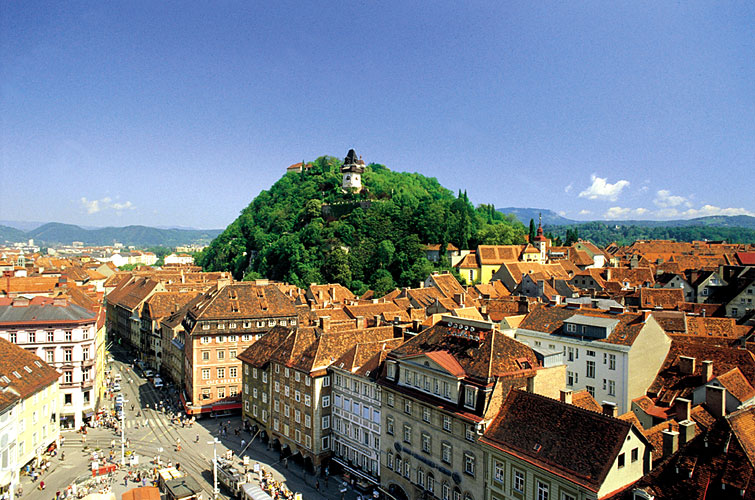
Graz is a beautiful European town that is dotted by hundreds of historical old buildings that were seemingly untouched by the hands of war all those years ago. Like so many other European towns, Graz is divided into two main areas – the old and the new town. Dividing these two main sections is the rapidly flowing Mur River that is presumably carrying with it the freezing waters from the nearby melting snow capped mountains.
What a great place to start our 2008 European Tour.
Damien Low
The orchestra has now all safely arrived in Graz, Austria after spending the previous 24 hours on a series of flights from Sydney through Singapore and Frankfurt. Miraculously not a single bag missed the connection in Frankfurt from our Qantas flight to our Lufthansa connection. This could be attributed to the fact that our Austrian travel agent looked after every detail of our connection in Frankfurt to the extent that they had cordoned off a check-in counter for the exclusive use of the ACO, or perhaps it could just be that the God of Luggage Handling (Heathrow does not fall under his/her jurisdiction) was in a good mood and smiled upon us.
Whatever the reason we are all here and reunited with our suitcases.
Our tour manager for the next few weeks is Reinhold Göggel who has already managed to gain the orchestra’s respect and admiration by ensuring that all the rooms at our hotel in Graz were ready for us at 1030 this morning. No small feat for a group of 26 people.
The orchestra now has the next 36 hours to acclimatise to the time zone and climate of our new environment before they start rehearsals with our soloists for the tour, Mark Padmore and Sol Gabetta. Now doubt this period of acclimatisation will also involve some time for the musicians to reacquaint themselves with the shopping, food and alcoholic beverages that this part of the world has to offer, test their newly purchased cameras, and of course polish up on the repertoire we will be performing in Europe over the course of the next few weeks. I think I can already hear a violin being tuned in the room next to mine.
Graz is a beautiful European town that is dotted by hundreds of historical old buildings that were seemingly untouched by the hands of war all those years ago. Like so many other European towns, Graz is divided into two main areas – the old and the new town. Dividing these two main sections is the rapidly flowing Mur River that is presumably carrying with it the freezing waters from the nearby melting snow capped mountains.
What a great place to start our 2008 European Tour.
Damien Low
Friday, 11 April 2008
OLD MUSIC MADE NEW
Friday is YouTube Day so we commend to you this excerpt from a stunning production of Rameau's opera, Les Paladins with early music ensemble, Les Arts Florissants. Rameau, a master of the French Baroque is distinguished by his virtuoso use of instrumental colour, daring harmony and gift for luscious melody.
The ACO will perform selections from another great Rameau opera, Dardanus, on tour in Europe.
The ACO will perform selections from another great Rameau opera, Dardanus, on tour in Europe.
Monday, 7 April 2008
RADIO/FACEBOOK
Stand aside Myspace and Facebook, one of our favourite bands has launched its own social networking site. Radiohead's, W.A.S.T.E. CENTRAL site lets groups of fans meet each other before concerts as well as post videos, photos and remixes.

Friday, 4 April 2008
HAPPY BIRTHDAY MAESTRO
April 5 is the centenary of Herbert von Karajan's birth. We leave it to you to decide whether the famous, prolific, ethically dubious and undeniably brilliant conductor deserves bouquets or brickbats.
Subscribe to:
Posts (Atom)