So, the Government had to abandon the idea of naming their new deracinated music education institution the Australian Institute of Music Performance (AIMP). Instead, it will continue to be the Australian National Academy of Music. This wasn't so much because they wanted to keep ANAM's students happy (or even so much as to trade on the exsiting reputation of the Organisation-Formerly-Known-As-ANAM), but because an Australian Institute of Music (AIM) already exists (it's located in Surry Hills, Sydney) - AIM was rightly angry. This gaffe led to the hasty decision that came from Canberra complete with patronising spin about 'connotations of excellence' and caring about the concerns of students.
On Tuesday, ANAM students staged a musical protest at Parliament House and then, with Artistic Director Brett Dean, met with Peter Garrett (read more) to lobby for a stay of execution. The Government has pledged $500 000 to ease the transition of ANAM into the University of Melbourne music faculty (press release). Rumour has it that such ad hoc policy-making has foisted ANAM upon the University of Melbourne, infuriating Melbourne Uni Vice Chancellor Glyn Davis.
You can still register your support of (the original) ANAM by signing the petition, calling your local MP or writing to Mr Garrett:
The Hon Peter Garrett AM MP
Minister for the Environment, Heritage and the Arts
Parliament House, Canberra, ACT 2600
Tel: (02) 6277 7640
Fax: (02) 6273 6101
Email: peter.garrett.mp@aph.gov.au
Whatever ANAM's problems were, it didn't deserve to be so ignominiously knackered by Rudd's razor-gangs. The whole affair could have been handled with a lot more tact.
Fortunately, this business can never diminish the talents or the reputations of the brilliant musicians and staff who continue to show the Government the true meanings of class and excellence.
The fight goes on.
Showing posts with label opinion. Show all posts
Showing posts with label opinion. Show all posts
Wednesday, 3 December 2008

Tuesday, 23 September 2008
Custodians of Culture
In a discussion on the blog about coughing and clapping, Alex Millier made the observation:
In his op-ed piece in the Weekend Australian, Greg Sheridan writes of his recent attendance at an Australian Chamber Orchestra concert that “There is precious little consolation to be found in classical composers of the 20th Century…. ..My complaint, really, is that the ACO played four Bach fugues but between every one interposed a Kurtag movement. That’s not really playing the game.”
Let’s examine these statements for a moment. With the flick of a keyboard, he opines about the worth of all “classical composers of the 20th century”. Granted, the generic descriptor of music performed by the ACO and other Australian orchestras is classical so I won’t have a semantic debate about the term here, but his description is a powerful reflection of the sort of music he feels is appropriate at a gentile gathering of “older women”.
We’re now in the 21st century. Can we presume, by their omission, that as the calendar flipped across on December 31 1999 that composers suddenly saw the errors of their ways and began to write works that consoled Mr Sheridan? Or maybe he should refer to them as contemporary composers, which would again include compositions created in the last 8 years.
He also referred to Vivaldi’s “The Four Seasons” as having the ability to “cheer one up”, as if they’re some sort of musical anti-depressant. Follow that line of argument, and we’ll never get to experience the musical depths of despair that some great examples of “Western Art Music” have to offer.
What exactly is “the game”? Is it one played by his rules? That is, we are consoled, or we are not consoled. The arts should know their place. They should not ever challenge their audiences.
In his op-ed piece in the Weekend Australian, Greg Sheridan writes of his recent attendance at an Australian Chamber Orchestra concert that “There is precious little consolation to be found in classical composers of the 20th Century…. ..My complaint, really, is that the ACO played four Bach fugues but between every one interposed a Kurtag movement. That’s not really playing the game.”
Let’s examine these statements for a moment. With the flick of a keyboard, he opines about the worth of all “classical composers of the 20th century”. Granted, the generic descriptor of music performed by the ACO and other Australian orchestras is classical so I won’t have a semantic debate about the term here, but his description is a powerful reflection of the sort of music he feels is appropriate at a gentile gathering of “older women”.
We’re now in the 21st century. Can we presume, by their omission, that as the calendar flipped across on December 31 1999 that composers suddenly saw the errors of their ways and began to write works that consoled Mr Sheridan? Or maybe he should refer to them as contemporary composers, which would again include compositions created in the last 8 years.
He also referred to Vivaldi’s “The Four Seasons” as having the ability to “cheer one up”, as if they’re some sort of musical anti-depressant. Follow that line of argument, and we’ll never get to experience the musical depths of despair that some great examples of “Western Art Music” have to offer.
What exactly is “the game”? Is it one played by his rules? That is, we are consoled, or we are not consoled. The arts should know their place. They should not ever challenge their audiences.
Monday, 25 August 2008
RT's Speech: Seventeen Forty Three
1743...
The third President of the United States, Thomas Jefferson, was born.
Incidentally he played the violin and declared that music “is the favourite passion of my soul, and fortune has cast my lot in a country where it is in a state of deplorable barbarism.” To improve the state of music in America, Jefferson encouraged its practice, and music played an important role in the life of his family through the generations.
Born: Sir Joseph Banks, British naturalist and botanist
Born: Spencer Compton, 1st Earl of Wilmington, second Prime Minister of the UK
Died: Anna Maria Luisa de' Medici, last member of the Medici family (b. 1667)
1743 was also the year that this violin was made. It is 265 years old.
Nicknamed the Carrodus was made by Guarnieri del Gesu in Cremona, Italy. If Stradivarius was the Leonardo of violin making then del Gesu was Michelangelo. Del Gesu (of Jesus) was an irascible genius whose instruments are even more highly sought after than those of Stradivarius. This instrument is now on Australian soil and an anonymous benefactor owns it. The spine-tingling fact about this instrument (apart from its value) is that it is made from the same tree as the il Cannone which was owned by Paganini. Indeed, it’s considered feasible that this instrument was also owned by Paganini but he lost it gambling.
“His pale, long-drawn face with its hollow cheeks, his thin lips that seemed to curl into a sardonic smile, piercing expression fo his eyes which were like flaming charcoals, gave him a diabolic appearance...” The ‘nail in the coffin’, so to speak, was that Paganini refused to see a Bishop that had come to give him the final sacraments when he was on his deathbed. Paganini shooed him away, insisting he was not dying at all. When he did die, the church refused to allow him to be buried on holy ground
I am honoured to be here to address you, and indeed I have my own Davos Connection:
In 1986 on a concert tour of Europe I took myself skiing in Davos, The book I was reading at the time mysteriously and remarkably mirrored the climb my train was making out of the Rhine Gebiet up through the mountains to Zurich and onto Davos. It wasn’t until I described my encounter to an Aus. girl later that night was I made aware that unknowingly I had been living the book I was reading. Quite coincidentally I was reading the opening chapter the Arrival beautiful description of travelling up through the Swiss mountains. It was no other than Thomas Mann’s Der Zauberberg (The Magic Mountain), which is a microcosmic study of symphonic proportions of the decaying Europe below. And of course it is based in a sanatorium in Davos.
Shortly after its publication in 1924 some rather important developments were taking place in our ‘faraway land’. Dame Nellie Melba had passed away in 1931, but an even more important series of events occurred which marks to date the most important climb in the culture of Australian music known as the Heinze Era 1932-1945 which was overseen by Prime Ministers James Henry Scullin, ALP, 1929 through to John Curtin up to 1945.
A great launch pad and a very encouraging start
In a recent book by Martin Buzacott (The Rite of Spring: 75 Years of ABC Music-making, ABC Books) we can read the story of the evolution of the state symphonies we have today.
But after 76 years we’ve not expanded, not one iota. The six symphony orchestras we formed in 1932 with a population of six and a half million (now it’s 21 million) are the same and only symphony orchestras extant today. Indeed their survival is constantly threatened.
For some comparative statistics consider:
Finland, population 5.1 million: 30 professional orchestras
USA, populations 301 million: 900 amateur and 300-400 professional orchestras
Venezuela, population 27 million: 200 youth orchestras and at least 23 professional orchestras (in the 1970s there were two orchestras in Venezuela).
Quite rightly there is enormous concern about our ‘outer ecology’ as you’ve just heard from the Governor General – we’re all alarmed about the impact of global warming, but I think we also need to consider our ‘inner ecology’, where ‘cultural cooling’ is just as real a threat to our well-being.
In this country there is an enormous imbalance between sporting prowess and cultural endeavour. Consider this:
The elite arts set is viewed as a privileged few, upper echelon, crème de la crème, snobs, snoots, elitists, pretenders, egotists, stuffed shirts and Chardonnay sipping wankers. Your progeny ought to be prevented from associating with these types.
The elite sports set, on the other hand, is seen as: the best, cream o’ the crop, our heroes, the future, something to shed a tear about, our obsession, worthy of investment, winning for our country. Our kids should be encouraged to follow in their hallowed footsteps.
Incidentally, in Buzacott’s book he describes the ‘agricultural roughness’ of conductor EJ Roberts, nicknamed ‘Shellshock’ and better known as a golfer than conductor who led the National Broadcasting Symphony Orchestra at the opening ceremony for the new Australian Broadcasting Commission on 1 July 1932.
We have become used to these negative sentiments in this country and they fuel an entrenched perception that the arts are elitist, exclusive, and indeed a burden on a society which has an ever increasing challenge to contain the disparity between the haves and the have-nots. It’s a luxury handbag rather than an essential item.
To indicate how easy it is to reinforce this sentiment in Australia consider this ad brought out by the Liberal Party in 1996: “A vote for Labor is a vote for the elite arts.”
Now just for a moment consider swapping ‘elite arts’ with ‘elite sports’ or elite immigrants or kooris.
Or recently a State Premiere staked his credentials on this: “I’m not into opera, I go to the footy.”
Since when were the two mutually exclusive?
Well, I surf and I play the violin.
I’ve been asked to talk about cultural leadership and I do believe that at this point in my career, advocacy is the best form of leadership.
I don’t have much time here and I have been asked to play for you some more so I’ll cut to the chase and be specific. I’ll leave the universal to JS Bach which I’ll play at the end.
In the strongest possible terms I am advocating a national music curriculum to be advanced unencumbered by the states’ educational differences and a visionary and far-reaching cultural infrastructural program be formulated that will help spawn a new generation of Australians that is culturally adept, well informed, open minded and with good reason proud of what we do on this land rather than what we do with it. A national smartening-up, not dumbing-down. Our exemplary sporting achievements – we all know that we punch way above our weight at present we rank number five on the Olympic ladder – ought to – and can be – matched by our cultural endeavours.
Currently in Australia up to three in four children in Government Primary Schools have no music teachers. That equates to over 700,000 children missing out, and often they are the ones who need support the most.
Kim Williams, CEO of Foxtel and a passionate advocate for music education was active participant in the 2020 summit which he believes lives and continues. In a recent speech he said:
If Australia is to continue to care about and embrace the notion of egalitarian ideals as the foundation of our culture then there is much work to be done.
In my view … the quality of that system will have several absolutely fundamental tenets:
First there have to be reliable national standards and national curriculum frameworks – and that is essentially non negotiable;
2) There have to be close delivery connections to local schools and school districts including the empowerment of school principals to appoint and assess teachers so that their performance is directly accountable in the same way that performance accountability is fundamental to all modern commercial and public life;
3) A mixed system will continue but it has to be one where the resource imbalance between public and private in the interests of fairness and equity must correct the systemic distortions that have eroded public education;
4) The whole approach and attitudinal fabric to the role, remuneration, training, assessment and reinforcement of teachers requires wholesale renovation so that we capture the right talented people who make teaching their first choice of career and we ensure that it is a satisfying and fulfilling one subsequently;
5) There must be an unwavering commitment to excellence – one which ensures that the talented are encouraged and appropriately reinforced; and
Finally there must be a real commitment to the primary importance of mainstream delivery of the arts and sport from infant education on as the ying and yang essential to a fit, intellectually vigorous and well resourced nation that is healthy and empowered to confront its challenges effectively.
He goes on to say:
I think I can assume safe common territory with everyone here today in saying that Australia is imbued with an unusually talented resource of active and original creative individuals quite disproportionate to its size. However that resource has an uneven education and resource framework compromising the nation’s capacity to retain talent and drive consistent effort that evolves and improves as boldly as it must to serve the people’s best interest.
Try telling the kids of Wyong Public in NSW, that your vote could be a vote for the elite arts. Consider this:
The Song Room a private organization whose vision whose vision statement is that all Australian children have the opportunity to participate in music and the arts to enhance their education, personal development and community involvement.
Wyong Public School Students to Learn the Violin and Increase Enrolments!
In early 2007 The Song Room secured the services of a string teacher one day a week at Wyong Public School on the Central Coast of NSW, to teach students to play the violin,
The achievements were beyond the wildest dreams of the whole school community. Only ten months after the students commenced The Song Room program, the school now has in excess of 90 students from Years 3-6 playing in a string ensemble. All of the students in these groups have had opportunities to perform, not only at the weekly school assembly, but also performing at various local Festivals. The School’s 90 violinists also featured on the local news in November showing the remarkable achievements being made by students in learning the violin in such large numbers.
Graham Holmes, Principal, Wyong Public School:
“The children of Wyong Public School largely come from backgrounds where these music and creative arts opportunities cannot normally be afforded to them. It has been through the support of The Song Room that has given these children experiences that they could have previously only stood back and watch other children enjoy. They have grown in their self esteem, in their sense of self, in their aspirational outlooks and most importantly, in their love of music and performance.”
According to Graham, music and performing arts can transform a school:
“It can be the key that unlocks the talents of children and it can play a defining role in uplifting children’s self esteem, broadening their career and personal aspirations and impressing on them that they can too reach their potential, regardless of their personal life’s circumstances.”
For one student who earlier this year had to be removed for several months to a specialist behaviour facility for seriously disruptive, and at times, violent behaviour, The Song Room program has left an indelible mark on his psyche and has set him on a life trajectory of music and performance.
From violence to violins.
There exist a few great models in the world where a good music education opens up enormous vistas and opportunities. I encourage you to examine the Finnish education system on the one hand and the world shattering success of the Venezuelan Youth Orchestra program (El Sistema) comprising street kids – certainly nothing to do with the elite except in their playing.
We need to work with the media to engage all in musical activities.
The idea of designating one Australian town or city annually to be the ‘Cultural Capital’ would serve to focus and stimulate local artists. Take for example NSW’s third largest city, Wollongong, where we find a city with a broken heart, lying supine in a cultural coma with no cultural infrastructure, except for their local theatre. The local council had recently condemned their only venue suitable for orchestral and chamber music performance, the Wollongong town hall.
Making the arts an important concern for a whole community for even just a year would have far-reaching effects in such a city, serving to generate a cultural dialogue with the rest of the country and the wider world.
Let me finish with a quote from Alan Turing the father of the computer.
If the untrained infant’s mind is to become an intelligent one, it must acquire both discipline and initiative… To convert a brain or machine into a universal machine is the most extreme form of discipline. Without something of this kind one cannot set up proper communication. But discipline is certainly not enough in itself to produce intelligence. That which is required in addition we call initiative. This statement will have to serve as a definition.
It’s no moot point that every senior secondary school student should have access to a computer at school.
So wouldn’t it be wonderful if placed next to that computer on every student’s desk were a musical instrument.
I’ll leave you with Bach’s Chaconne.
This is a transcript of a speech RT made at the Australian Davos Connection's Leadership Retreat.
The third President of the United States, Thomas Jefferson, was born.
Incidentally he played the violin and declared that music “is the favourite passion of my soul, and fortune has cast my lot in a country where it is in a state of deplorable barbarism.” To improve the state of music in America, Jefferson encouraged its practice, and music played an important role in the life of his family through the generations.
Born: Sir Joseph Banks, British naturalist and botanist
Born: Spencer Compton, 1st Earl of Wilmington, second Prime Minister of the UK
Died: Anna Maria Luisa de' Medici, last member of the Medici family (b. 1667)
1743 was also the year that this violin was made. It is 265 years old.
Nicknamed the Carrodus was made by Guarnieri del Gesu in Cremona, Italy. If Stradivarius was the Leonardo of violin making then del Gesu was Michelangelo. Del Gesu (of Jesus) was an irascible genius whose instruments are even more highly sought after than those of Stradivarius. This instrument is now on Australian soil and an anonymous benefactor owns it. The spine-tingling fact about this instrument (apart from its value) is that it is made from the same tree as the il Cannone which was owned by Paganini. Indeed, it’s considered feasible that this instrument was also owned by Paganini but he lost it gambling.
“His pale, long-drawn face with its hollow cheeks, his thin lips that seemed to curl into a sardonic smile, piercing expression fo his eyes which were like flaming charcoals, gave him a diabolic appearance...” The ‘nail in the coffin’, so to speak, was that Paganini refused to see a Bishop that had come to give him the final sacraments when he was on his deathbed. Paganini shooed him away, insisting he was not dying at all. When he did die, the church refused to allow him to be buried on holy ground
I am honoured to be here to address you, and indeed I have my own Davos Connection:
In 1986 on a concert tour of Europe I took myself skiing in Davos, The book I was reading at the time mysteriously and remarkably mirrored the climb my train was making out of the Rhine Gebiet up through the mountains to Zurich and onto Davos. It wasn’t until I described my encounter to an Aus. girl later that night was I made aware that unknowingly I had been living the book I was reading. Quite coincidentally I was reading the opening chapter the Arrival beautiful description of travelling up through the Swiss mountains. It was no other than Thomas Mann’s Der Zauberberg (The Magic Mountain), which is a microcosmic study of symphonic proportions of the decaying Europe below. And of course it is based in a sanatorium in Davos.
Shortly after its publication in 1924 some rather important developments were taking place in our ‘faraway land’. Dame Nellie Melba had passed away in 1931, but an even more important series of events occurred which marks to date the most important climb in the culture of Australian music known as the Heinze Era 1932-1945 which was overseen by Prime Ministers James Henry Scullin, ALP, 1929 through to John Curtin up to 1945.
A great launch pad and a very encouraging start
In a recent book by Martin Buzacott (The Rite of Spring: 75 Years of ABC Music-making, ABC Books) we can read the story of the evolution of the state symphonies we have today.
But after 76 years we’ve not expanded, not one iota. The six symphony orchestras we formed in 1932 with a population of six and a half million (now it’s 21 million) are the same and only symphony orchestras extant today. Indeed their survival is constantly threatened.
For some comparative statistics consider:
Finland, population 5.1 million: 30 professional orchestras
USA, populations 301 million: 900 amateur and 300-400 professional orchestras
Venezuela, population 27 million: 200 youth orchestras and at least 23 professional orchestras (in the 1970s there were two orchestras in Venezuela).
Quite rightly there is enormous concern about our ‘outer ecology’ as you’ve just heard from the Governor General – we’re all alarmed about the impact of global warming, but I think we also need to consider our ‘inner ecology’, where ‘cultural cooling’ is just as real a threat to our well-being.
In this country there is an enormous imbalance between sporting prowess and cultural endeavour. Consider this:
The elite arts set is viewed as a privileged few, upper echelon, crème de la crème, snobs, snoots, elitists, pretenders, egotists, stuffed shirts and Chardonnay sipping wankers. Your progeny ought to be prevented from associating with these types.
The elite sports set, on the other hand, is seen as: the best, cream o’ the crop, our heroes, the future, something to shed a tear about, our obsession, worthy of investment, winning for our country. Our kids should be encouraged to follow in their hallowed footsteps.
Incidentally, in Buzacott’s book he describes the ‘agricultural roughness’ of conductor EJ Roberts, nicknamed ‘Shellshock’ and better known as a golfer than conductor who led the National Broadcasting Symphony Orchestra at the opening ceremony for the new Australian Broadcasting Commission on 1 July 1932.
We have become used to these negative sentiments in this country and they fuel an entrenched perception that the arts are elitist, exclusive, and indeed a burden on a society which has an ever increasing challenge to contain the disparity between the haves and the have-nots. It’s a luxury handbag rather than an essential item.
To indicate how easy it is to reinforce this sentiment in Australia consider this ad brought out by the Liberal Party in 1996: “A vote for Labor is a vote for the elite arts.”
Now just for a moment consider swapping ‘elite arts’ with ‘elite sports’ or elite immigrants or kooris.
Or recently a State Premiere staked his credentials on this: “I’m not into opera, I go to the footy.”
Since when were the two mutually exclusive?
Well, I surf and I play the violin.
I’ve been asked to talk about cultural leadership and I do believe that at this point in my career, advocacy is the best form of leadership.
I don’t have much time here and I have been asked to play for you some more so I’ll cut to the chase and be specific. I’ll leave the universal to JS Bach which I’ll play at the end.
In the strongest possible terms I am advocating a national music curriculum to be advanced unencumbered by the states’ educational differences and a visionary and far-reaching cultural infrastructural program be formulated that will help spawn a new generation of Australians that is culturally adept, well informed, open minded and with good reason proud of what we do on this land rather than what we do with it. A national smartening-up, not dumbing-down. Our exemplary sporting achievements – we all know that we punch way above our weight at present we rank number five on the Olympic ladder – ought to – and can be – matched by our cultural endeavours.
Currently in Australia up to three in four children in Government Primary Schools have no music teachers. That equates to over 700,000 children missing out, and often they are the ones who need support the most.
Kim Williams, CEO of Foxtel and a passionate advocate for music education was active participant in the 2020 summit which he believes lives and continues. In a recent speech he said:
If Australia is to continue to care about and embrace the notion of egalitarian ideals as the foundation of our culture then there is much work to be done.
In my view … the quality of that system will have several absolutely fundamental tenets:
First there have to be reliable national standards and national curriculum frameworks – and that is essentially non negotiable;
2) There have to be close delivery connections to local schools and school districts including the empowerment of school principals to appoint and assess teachers so that their performance is directly accountable in the same way that performance accountability is fundamental to all modern commercial and public life;
3) A mixed system will continue but it has to be one where the resource imbalance between public and private in the interests of fairness and equity must correct the systemic distortions that have eroded public education;
4) The whole approach and attitudinal fabric to the role, remuneration, training, assessment and reinforcement of teachers requires wholesale renovation so that we capture the right talented people who make teaching their first choice of career and we ensure that it is a satisfying and fulfilling one subsequently;
5) There must be an unwavering commitment to excellence – one which ensures that the talented are encouraged and appropriately reinforced; and
Finally there must be a real commitment to the primary importance of mainstream delivery of the arts and sport from infant education on as the ying and yang essential to a fit, intellectually vigorous and well resourced nation that is healthy and empowered to confront its challenges effectively.
He goes on to say:
I think I can assume safe common territory with everyone here today in saying that Australia is imbued with an unusually talented resource of active and original creative individuals quite disproportionate to its size. However that resource has an uneven education and resource framework compromising the nation’s capacity to retain talent and drive consistent effort that evolves and improves as boldly as it must to serve the people’s best interest.
Try telling the kids of Wyong Public in NSW, that your vote could be a vote for the elite arts. Consider this:
Case Study - Wyong Public School
The Song Room a private organization whose vision whose vision statement is that all Australian children have the opportunity to participate in music and the arts to enhance their education, personal development and community involvement.
Wyong Public School Students to Learn the Violin and Increase Enrolments!
In early 2007 The Song Room secured the services of a string teacher one day a week at Wyong Public School on the Central Coast of NSW, to teach students to play the violin,
The achievements were beyond the wildest dreams of the whole school community. Only ten months after the students commenced The Song Room program, the school now has in excess of 90 students from Years 3-6 playing in a string ensemble. All of the students in these groups have had opportunities to perform, not only at the weekly school assembly, but also performing at various local Festivals. The School’s 90 violinists also featured on the local news in November showing the remarkable achievements being made by students in learning the violin in such large numbers.
Graham Holmes, Principal, Wyong Public School:
“The children of Wyong Public School largely come from backgrounds where these music and creative arts opportunities cannot normally be afforded to them. It has been through the support of The Song Room that has given these children experiences that they could have previously only stood back and watch other children enjoy. They have grown in their self esteem, in their sense of self, in their aspirational outlooks and most importantly, in their love of music and performance.”
According to Graham, music and performing arts can transform a school:
“It can be the key that unlocks the talents of children and it can play a defining role in uplifting children’s self esteem, broadening their career and personal aspirations and impressing on them that they can too reach their potential, regardless of their personal life’s circumstances.”
For one student who earlier this year had to be removed for several months to a specialist behaviour facility for seriously disruptive, and at times, violent behaviour, The Song Room program has left an indelible mark on his psyche and has set him on a life trajectory of music and performance.
From violence to violins.
There exist a few great models in the world where a good music education opens up enormous vistas and opportunities. I encourage you to examine the Finnish education system on the one hand and the world shattering success of the Venezuelan Youth Orchestra program (El Sistema) comprising street kids – certainly nothing to do with the elite except in their playing.
We need to work with the media to engage all in musical activities.
The idea of designating one Australian town or city annually to be the ‘Cultural Capital’ would serve to focus and stimulate local artists. Take for example NSW’s third largest city, Wollongong, where we find a city with a broken heart, lying supine in a cultural coma with no cultural infrastructure, except for their local theatre. The local council had recently condemned their only venue suitable for orchestral and chamber music performance, the Wollongong town hall.
Making the arts an important concern for a whole community for even just a year would have far-reaching effects in such a city, serving to generate a cultural dialogue with the rest of the country and the wider world.
Let me finish with a quote from Alan Turing the father of the computer.
If the untrained infant’s mind is to become an intelligent one, it must acquire both discipline and initiative… To convert a brain or machine into a universal machine is the most extreme form of discipline. Without something of this kind one cannot set up proper communication. But discipline is certainly not enough in itself to produce intelligence. That which is required in addition we call initiative. This statement will have to serve as a definition.
It’s no moot point that every senior secondary school student should have access to a computer at school.
So wouldn’t it be wonderful if placed next to that computer on every student’s desk were a musical instrument.
I’ll leave you with Bach’s Chaconne.
This is a transcript of a speech RT made at the Australian Davos Connection's Leadership Retreat.
Tuesday, 1 July 2008
Intense Isserlis

Cellist Steven Isserlis (touring with us in August) has many strings to his bow, one of which is regularly contributing to newspapers (he's also written children's books). Here's a selection of his opinion pieces about being a performer and other musical matters:
The Bach Suites
Beethoven Cello Sonatas
When he's not writing about composers, he's done pieces on:
Playing chamber music with irregular partners
Hitler's record collection
The difficulties of travelling with a cello
Thursday, 5 June 2008
Ratbags From the End of the World...
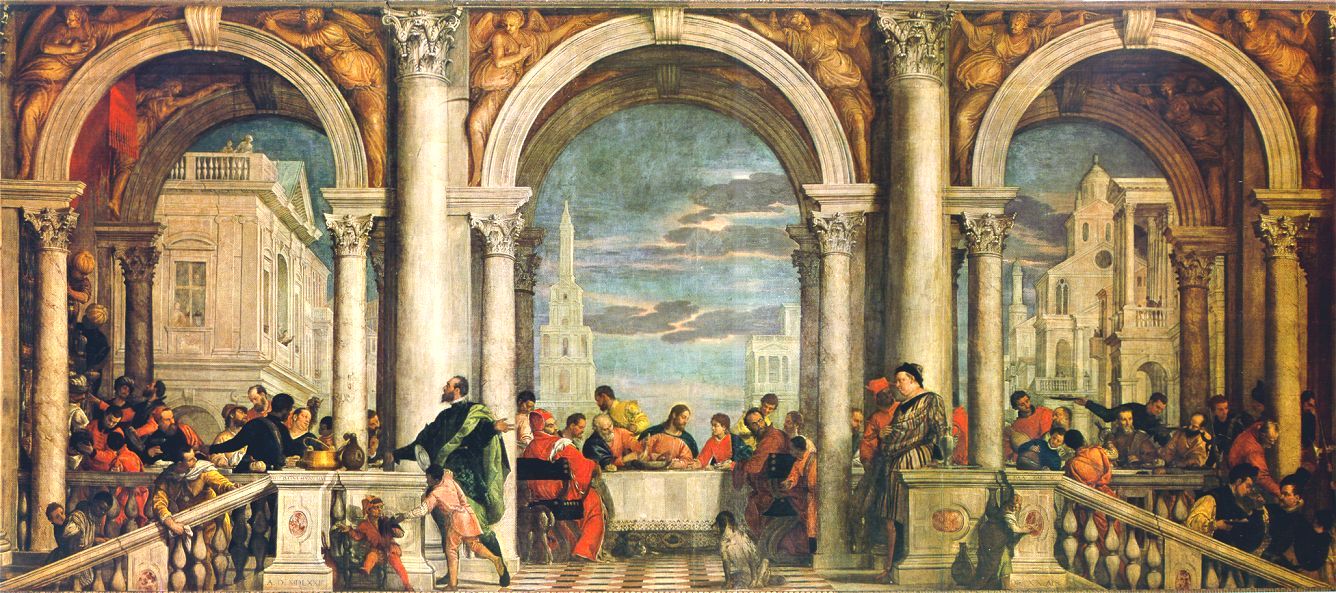 Veronese: The Feast in the House of Levi (AKA The Last Supper)
Thoughts about artists and Ratbags, here and abroad: a ramble and a brief history.
(RT's speech for The Sydney Institute from 2006)
Monday, 26 May 2008

Thursday, 15 May 2008
A Modest Proposal for Wollongong

[Marcus Westbury] also looks at how we rank our cultural priorities. The multimillion-dollar upgrade to the Regional Arts Centre in his home town of Newcastle prompts him to question the value of arts institutions and ask whether we can buy art by building iconic centres such as the Guggenheim in Bilbao. The Sydney Morning Herald 15/10/07
While some arts commentators question the usefulness of institutions for the display, performance and “consumption” of art, the ACO is rather attached to those places as it’s good to have a roof over one's head when performing. The Wollongong Council has once again postponed a decision on whether to demolish the Wollongong Town Hall, until recently the ACO’s Wollongong performance venue.
But perhaps the Wollongong Council shouldn’t wait much longer to get rid of Town Hall? Destroying it would be a progressive - even Boulezian - move: as we all now know, the art of the future is to be found in the graffiti-daubed streets or on the rubble of demolished civic theaters and Town Halls rather than concert halls and boring museums.
Compared to the visual and aural splendours of Grand Theft Auto IV, orchestral concerts aren’t much chop, are they? And why bother with fly-weight “painters” like Manet (Fig. 1) when there’s mordant political commentary on the walls of Hosier Lane, Melbourne (Fig. 2).
 Fig. 2 Detail, Hosier Lane Graffito c. 2007
Nuance, depth and originality of thought are, like, so 19th Century.
We predict that once it gets rid of its tired institutions, Wollongong will be the art capital of Australia.
M. Croche
Monday, 31 March 2008
IN THE (NEW MUSIC) GHETTO
The Australian’s music critic Matthew Westwood writes about new music and the many opportunities that audience will have to hear it in the next few weeks. Few art forms are as divisive as contemporary music – as evidenced by the letters that we get after a performance. It’s true that not all new music is easy to love. But then, plenty of other contemporary art works are just as difficult. It’s always struck me as odd that plenty of people flock to see difficult movies, read challenging novels or visit art galleries but seem to be afraid that listening to a new piece of music is going to be such an intensely disturbing experience that they’ll never be the same again. Maybe that’s a good thing though. Why bother to experience something if it’s not going to affect you in some way?
Westwood points out that the ‘most visible purveyors of classical music’ are programming new music mini-festivals. But I wonder if this is of any value to new music. The MSO’s Metropolis Series and the Sydney Symphony’s 20th century music festival [‘A Celebration of the Colour of Time’] with David Robertson – as excellent as the programming is – continue to ‘ghettoise’ new music. By placing it in a separate series, often in a different venue, they send a message to their mainstage audience which says ‘you probably won’t like this so we won’t inflict it upon you.’ Instead of giving their audiences to opportunity to discover something new, they continue to feed them the same diet of warhorses, and then market their contemporary concerts to the same small group of listeners. A group which will continue to stay small until orchestras commit to growing it by exposing their entire audience to the best of what’s new.
Matthew Hindson’s new work – like several of the new Australian pieces that the SSO commissioned for 2008 – has been safely tucked away in their Meet the Music series, a set of concerts aimed at secondary school students. Happily, kids seem to be much more open to new sounds than adults so these works will fall on appreciative ears.
And what about new music from countries other than Australia? If you want an immersion in the latest music from around the world you can check out the MSO’s Metropolis series or (subtle plug) come to our Audacious tour in July.
Robert Murray
Westwood points out that the ‘most visible purveyors of classical music’ are programming new music mini-festivals. But I wonder if this is of any value to new music. The MSO’s Metropolis Series and the Sydney Symphony’s 20th century music festival [‘A Celebration of the Colour of Time’] with David Robertson – as excellent as the programming is – continue to ‘ghettoise’ new music. By placing it in a separate series, often in a different venue, they send a message to their mainstage audience which says ‘you probably won’t like this so we won’t inflict it upon you.’ Instead of giving their audiences to opportunity to discover something new, they continue to feed them the same diet of warhorses, and then market their contemporary concerts to the same small group of listeners. A group which will continue to stay small until orchestras commit to growing it by exposing their entire audience to the best of what’s new.
Matthew Hindson’s new work – like several of the new Australian pieces that the SSO commissioned for 2008 – has been safely tucked away in their Meet the Music series, a set of concerts aimed at secondary school students. Happily, kids seem to be much more open to new sounds than adults so these works will fall on appreciative ears.
And what about new music from countries other than Australia? If you want an immersion in the latest music from around the world you can check out the MSO’s Metropolis series or (subtle plug) come to our Audacious tour in July.
Robert Murray
Subscribe to:
Posts (Atom)